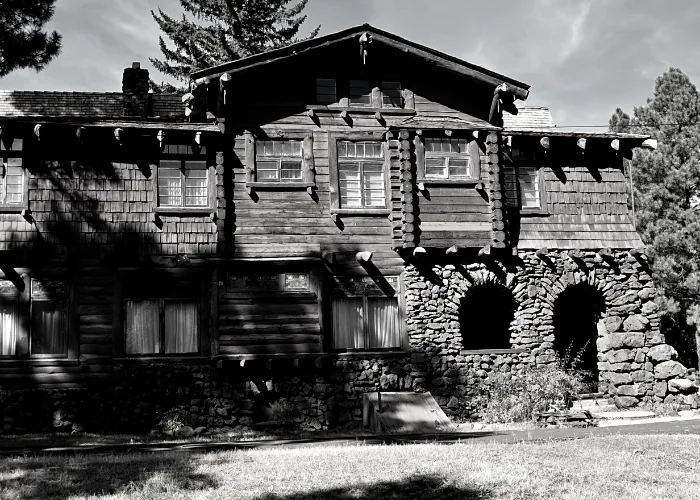
Ask Arizona State Parks and you get the plainest answer in Flagstaff: the park's own visitor FAQ says no, and staff report no documented supernatural experiences in the decades since the home became a state park. Ask around town long enough and you hear other things: stories the Riordan family themselves told while they lived here, and visitors who say the upstairs does not feel empty. Both answers are part of the record, so this page gives you both, along with the history that makes the house worth asking about.
Riordan Mansion sits at 409 West Riordan Road beside the Northern Arizona University campus, a state historic park in the pines whose interior opens by guided tour only. It is not a stop on our walking tours, so what follows is our honest account from outside the fence: the family, the house, the sorrow it carries, the stories people repeat and the park's own position.
The family that built Flagstaff
A few names stand above the rest in Flagstaff's history, the Babbitts and the Verkamps among them, and the Riordans stood as tall as any. Denis Matthew Riordan came west from Chicago first and impressed E.E. Ayer, owner of the local lumber mill, while serving as the government's Indian agent at Fort Defiance. He took over managing the mill, sent for his two half-brothers, Timothy and Michael, and before long the brothers ran the operation as the Arizona Lumber and Timber Company. When Denis sold his share and moved on, Tim and Michael stayed, and their lumber money reached into railroads, cattle, banking and territorial politics.
The two were an unlikely pair, Tim a rugged six-foot-two outdoorsman, Michael a quieter man who had planned on the Jesuit priesthood before tuberculosis redirected his life. They married sisters, Caroline and Elizabeth Metz of Cincinnati, and the two couples decided to live not just near each other but together.
One house, two wings, 1904
In 1904 the families raised a 13,000 square foot Arts and Crafts duplex designed by Charles Whittlesey, the architect of the El Tovar Hotel at the Grand Canyon. Each family took a 6,000 square foot wing, near mirror images of each other, joined by a broad common room the families used for billiards and gatherings. The exterior wears log-slab walls, wood shingles and arches of native stone, a mansion dressed as a mountain cabin, with servant quarters, indoor bathrooms and bedrooms enough for two large families inside. Flagstaff dubbed the double home Riordan Mansion, and the name stuck.
1927, the family's saddest year
The house carries a documented sorrow beneath the craftsmanship. In 1927, Michael's oldest son Arthur and Tim's youngest daughter Anna died within hours of each other from complications of polio, cousins lost to the same disease on the same day. By every account the family was never quite the same afterward, and it is Anna's name that comes up most often in the stories visitors tell about the house today.
The stories people tell
The lore starts with the Riordans themselves. The family told of a phantom billiards player, the click and roll of balls from the empty common room when no one else was home. The best-known story belongs to Caroline. She kept a small light always burning in the home's chapel alcove, and the story goes that when the light went out on its own one day, word reached the house within the hour that Caroline had died at that same moment.
What visitors report today is quieter and harder to pin down: a woman's presence upstairs, most often said to be Caroline keeping watch over Anna; footsteps in rooms that should be empty; the sense of being watched on the staircase. The reports stay remarkably consistent, gentle, watchful, never hostile. If local accounts are right and something lingers here, it lingers the way the family lived, quietly.
What the park says
Here is the other side, plainly given. The park's own FAQ answers the ghost question with a flat no, adding that staff have recorded no supernatural experiences since the home became a park. The rangers and docents who protect this house spend more hours inside it than anyone alive, and their answer deserves to be heard exactly as they give it. We tell ghost stories for a living, and we will not manufacture one here: the family-era stories are lore, the visitor reports are reports, and the park's records are clean. Take the tour and decide what the upstairs feels like.
Visiting Riordan Mansion
The mansion survived because the family barely changed it. Robert Chambers, a member of the family, donated the home to the state in 1978; the east wing opened to visitors in 1983 and the west wing followed in 2002, with much of the family's own furniture still in place. The park is open daily except Christmas, and the interior is seen by guided tour only. Tours run through the day, capacity is small, and Arizona State Parks recommends reserving ahead online or by phone.
Questions people ask
Is Riordan Mansion haunted?
The park says no: its official FAQ reports no documented supernatural experiences since it opened to the public as a state park in 1983. The lore says the question is fair: the Riordan family themselves told of a phantom billiards player and a chapel light that went out at the moment Caroline Riordan died, and some visitors describe a gentle, watchful presence upstairs linked to Caroline and her daughter Anna, who died of polio in 1927.
Can you tour Riordan Mansion?
Yes. Riordan Mansion State Historic Park at 409 West Riordan Road, beside the Northern Arizona University campus, is open daily except Christmas, and the mansion's interior is seen by guided tour only. Tours run through the day with limited capacity, so Arizona State Parks recommends reserving a spot ahead of time online or by phone.
Who were the Riordans?
Timothy and Michael Riordan were lumber-baron brothers who ran the Arizona Lumber and Timber Company and helped shape early Flagstaff and northern Arizona through lumber, railroads, cattle, banking and politics. The brothers married sisters, Caroline and Elizabeth Metz, and in 1904 built the 13,000 square foot double home, designed by El Tovar architect Charles Whittlesey, that is now the state historic park.
Walk the town the Riordans built

The mansion keeps its own quiet, but the fortune that built it made downtown Flagstaff, and downtown is where the documented hauntings live. The Downtown Flagstaff Haunted History Tour departs at 7 PM from Wheeler Park, runs 75 minutes at an easy pace and costs $29 for adults, $25 for students and $22 for children, telling stories researched by our co-founder Susan Johnson, author of Haunted Flagstaff. For more places with stories, see the Hotel Monte Vista and Weatherford Hotel pages, the full Flagstaff haunted places guide, and the haunted hotels overnight guide if you want to sleep where the stories happened.
Company-wide, Freaky Foot Tours holds a 4.9 of 5 rating across 325+ TripAdvisor reviews as of July 2026 and ranks #1 of 65 Tours and Activities in Flagstaff on TripAdvisor. 1,000+ five-star reviews. Best of Flagstaff three years running. Check current departure times in the booking calendar below.


